Building a Data Foundation for Future AI Initiatives
Updated: Oct 1
AI Ambition Is Moving Faster Than Data Readiness
For many executive teams, the AI conversation has moved from whether to invest to where to begin and how to scale. Yet the pressure to demonstrate progress can encourage a tool-first response: license Copilot, launch a pilot, connect a model to a document repository and hope value follows. That approach may produce an impressive demonstration, but it rarely creates a repeatable enterprise capability.
The underlying issue is that AI consumes, transforms and generates information at a speed and scale that exposes weaknesses traditional reporting environments can hide. Duplicate customer records, conflicting definitions, unclear ownership, stale policies and uncontrolled document versions do not disappear when AI is introduced. They become inputs to automated recommendations, generated content and agentic actions.
McKinsey argues that scaling AI requires structured and unstructured data to be connected through a governed, traceable and reusable foundation. Its analysis also makes an important distinction for leaders: searchable information is not automatically usable by AI. Context, versioning, lineage and access controls still matter.
What an AI-Ready Data Foundation Actually Includes
An AI-ready data foundation is not a single platform or migration program. It is the combination of business decisions, accountabilities, standards and technical capabilities that make information trustworthy and usable across analytics, automation and AI.
Six elements deserve executive attention:
Business-aligned priorities. Start with the decisions, processes and customer outcomes the organisation wants to improve. A use-case portfolio creates focus and prevents expensive attempts to clean or consolidate every dataset at once.
Clear ownership and common meaning. Critical data domains need accountable owners and stewards. Definitions for customers, products, services, risk, revenue and performance must be agreed so that reporting, CRM, automation and AI do not interpret the same concept differently.
Fit-for-purpose quality. Quality thresholds should reflect the consequence of the use case. A low-risk drafting assistant and an AI-supported eligibility decision do not require the same controls. Accuracy, completeness, timeliness and provenance should be measured against the business and risk context.
Governed access and security. Microsoft describes data governance as the processes, policies, roles, metrics and standards that keep data secure, private, accurate and usable throughout its lifecycle. For AI, controls must extend beyond storage to retrieval, prompts, generated outputs and integrations.
Architecture for reuse. A modern data platform should make trusted data products, metadata, lineage and integration services reusable across multiple use cases. This reduces duplicated pipelines and allows new initiatives to build on common foundations rather than recreate them.
Monitoring and continuous improvement. Data and AI environments change. Sources, policies, models and user behaviour evolve, so leaders need ongoing measures for quality, usage, access, drift, reliability and business outcomes.
The C-Suite Decisions that Determine Whether the Foundation Holds
Building the foundation is not an IT clean-up project. It requires decisions that sit across business strategy, operating model, risk and investment. Executive teams should agree which outcomes justify the work, who owns key data domains, what level of risk is acceptable, how initiatives will be prioritised and which capabilities should be bought, configured or built.
Governance should also be designed as an enabler, not a gate added at the end. Microsoft’s AI governance guidance recommends integrating AI risk management with broader cybersecurity, privacy and enterprise risk practices. IBM similarly frames scalable enterprise AI around four connected pillars: AI governance, AI security, data governance and data security. The practical implication is that data, technology, security, legal, risk, and business leaders need one operating rhythm rather than separate approval paths.
A useful governance model includes a senior forum that validates priorities, funding and risk appetite, supported by a working group that assesses use cases, data readiness, feasibility, adoption and measurable value. Each initiative should have an accountable business sponsor, named data owners, defined success measures and a clear path from pilot to production and optimisation.
A Practical Roadmap: Start Narrow, Design for Scale
The best starting point is neither a multi-year transformation nor an uncontrolled pilot. It is a bounded, valuable use case that reveals what must be strengthened while producing evidence for the next investment decision.
First, clarify the business outcome and map the decisions, workflows and information the use case depends on.
Second, assess the relevant structured and unstructured data for quality, sensitivity, ownership, lineage and accessibility.
Third, establish minimum governance, security and human-oversight requirements that reflect the level of consequence.
Fourth, build the reusable data, integration and monitoring components needed for delivery.
Finally, measure both technical performance and business impact, then feed what was learned into the wider roadmap.
This approach avoids the false choice between "fix all the data first" and "move fast without foundations". It creates progressive readiness: every priority use case improves the shared environment, and every shared capability lowers the cost and risk of the next initiative.
How Solentive Connects Strategy, Data and AI Execution
Solentive’s approach begins with business outcomes, not a preferred technology. We help executive teams define a practical Digital, Data and AI strategy, establish governance and ownership, and prioritise initiatives through a defensible roadmap. That strategy can then move through discovery, implementation, enablement and ongoing optimisation rather than being left as a standalone document.
For leaders, the benefit is a single line of sight from ambition to execution: the business outcome defines the use case, the data foundation supports trusted delivery, governance makes risk visible, and implementation measures whether the change improves day-to-day operations.
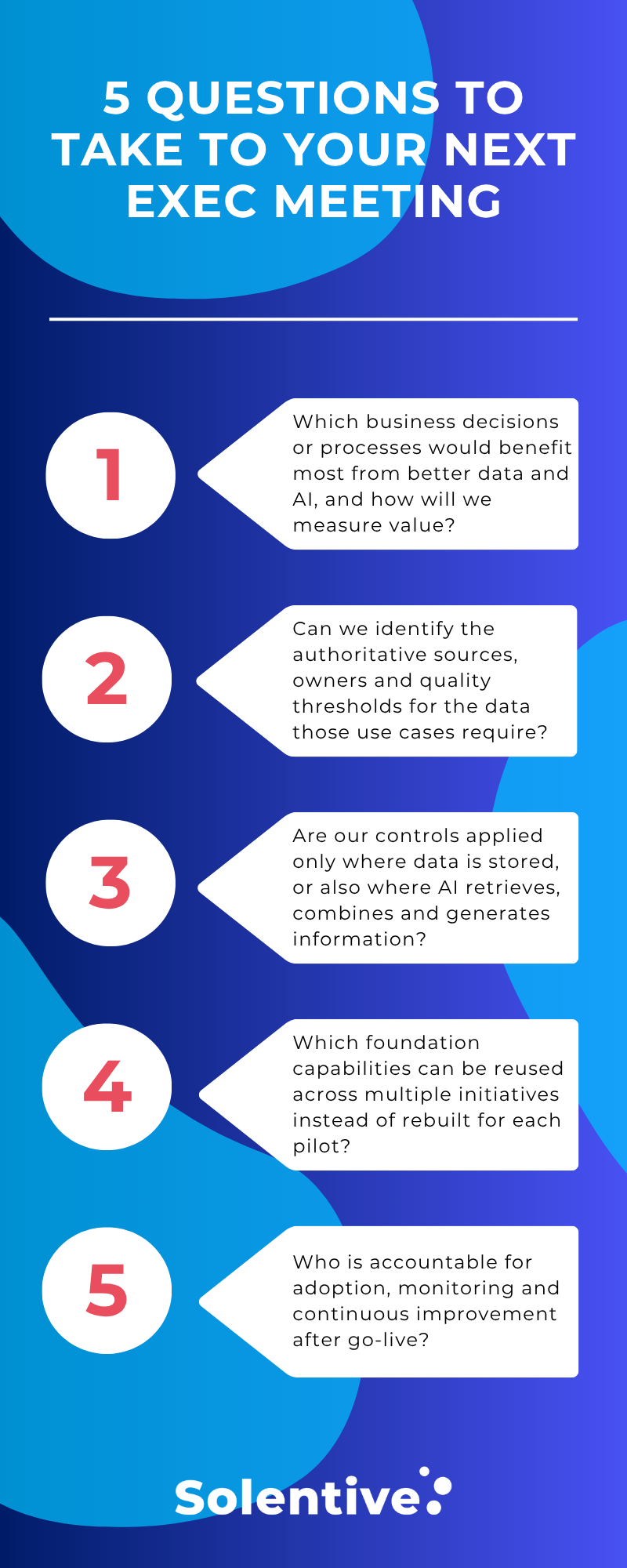
Build Confidence Before You Build Complexity
Future AI initiatives will depend less on access to models, which is rapidly becoming democratised, and more on an organisation’s ability to connect trustworthy data, clear governance and disciplined execution. The organisations that create this foundation now will be better positioned to move from isolated experimentation to AI that is reliable, explainable and integrated into how the business operates.
If your organisation is evaluating AI opportunities, struggling with fragmented data or unsure how to connect governance with delivery, Solentive can help you assess readiness, define the roadmap and implement the foundations needed for measurable outcomes.
Ready to build the foundations for responsible, scalable AI?
Talk to us about AI Readiness, Data Strategy and Governance, Modern Data Platforms and fit-for-purpose AI Delivery.


Comments